
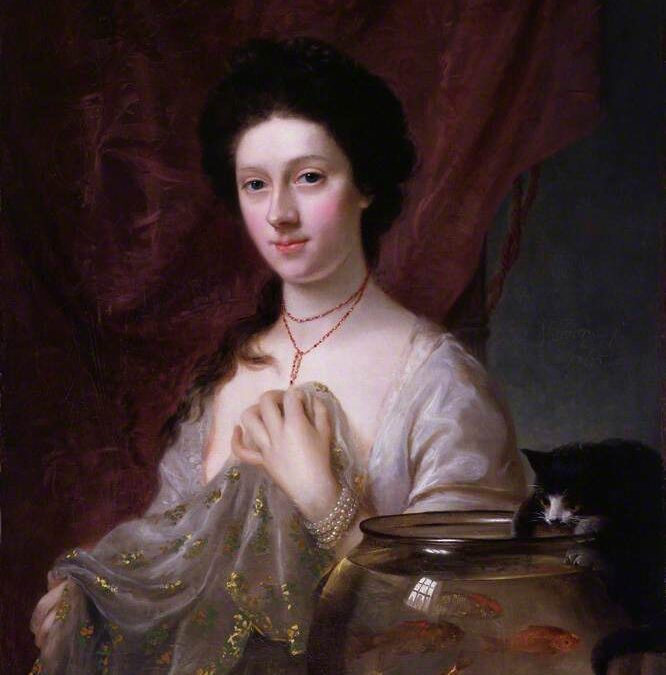
Kitty Fisher
Georgian London’s First Celebrity
Featured Image: Nathaniel Hone, Kitty Fisher, 1765. Oil on canvas, 749 × 622 mm. National Portrait Gallery, London (NPG 2354). Public domain, via Wikimedia Commons.
Humble Beginnings
Catherine Maria Fischer was born on 1 June 1741 in London, the daughter of a German-born tradesman and his wife.[i] Very little is known of her earliest years with any certainty, though a satirical pamphlet published in 1759 described her parentage as “low and mean,”[ii] a phrase that tells us more about the snobberies of the age than it does about the Fischer family themselves. What can be said is that young Catherine grew up in modest, perhaps straitened, circumstances—far removed from the glittering drawing rooms she would later inhabit.
As a young woman, she found employment as a milliner, crafting and selling hats and accessories in one of London’s many small workshops.[iii] Millinery was a common occupation for women of limited means in the mid-eighteenth century, offering a foothold in the margins of polite society. It was respectable enough work, but it also placed her in proximity to a wealthier clientele—and, crucially, to the men who accompanied them. It was in this milieu that Catherine Fischer began her transformation into “Kitty Fisher,” a name that would soon be on every tongue in London.
The Fall That Made a Celebrity
By the late 1750s, Fisher had already begun to attract notice among London’s fashionable set. But it was a single, dramatic event in the spring of 1759 that catapulted her into the public consciousness. On 12 March of that year, while taking a morning ride through the parks near St James’s, dressed in a stylish black riding habit atop a spirited piebald horse, Fisher’s mount was startled by a rank of soldiers.[iv] The horse bolted, then stopped abruptly and reared, throwing its rider to the ground. In an era before women wore split-leg undergarments, the fall was as revealing as it was undignified.
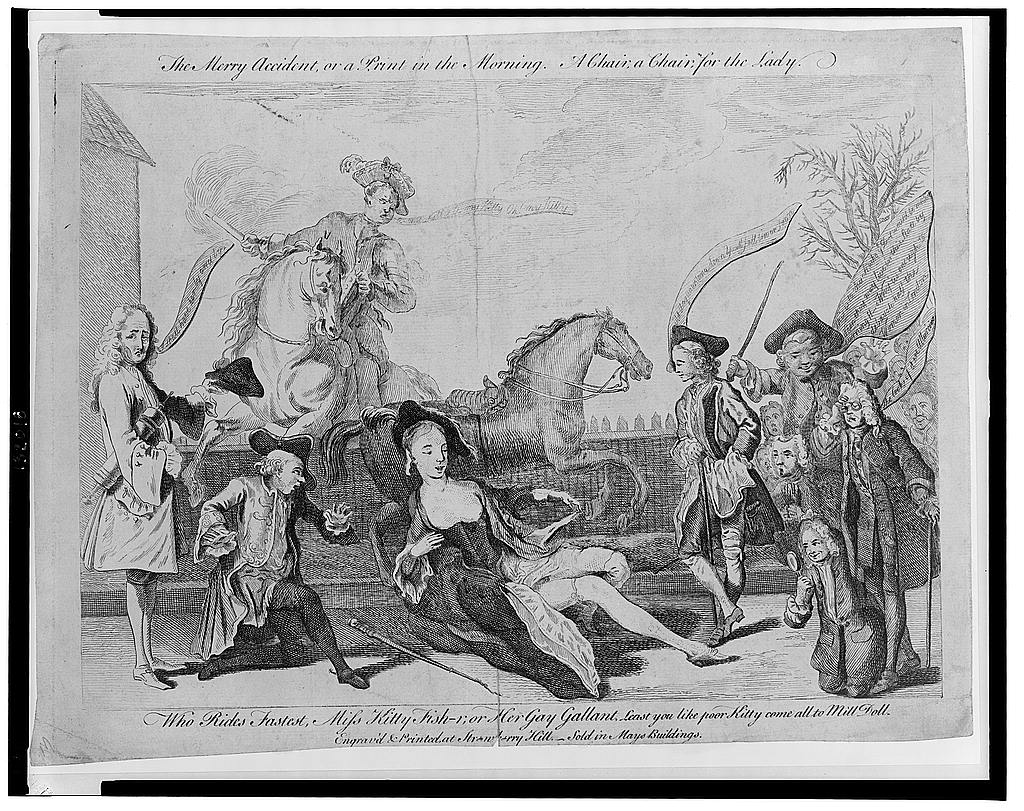
“The Merry Accident, or a Print in the Morning: A Chair, a Chair, for the Lady,” c. 1759. Engraving. Library of Congress, Prints and Photographs Division, British Cartoon Prints Collection (LC-USZ62-132018).
The incident was an immediate sensation. Within days, broadsheets, ballads, and satirical prints flooded London’s streets, gleefully punning on the image of a “fallen woman.”[v] Printmakers rushed out crude woodcuts; versifiers composed mocking ballads; gossip-hungry readers devoured every scrap of detail. Fisher’s humiliation might have ended many a reputation, but she proved shrewder than her detractors. Rather than retreating from the spotlight, she seized it. She commissioned Sir Joshua Reynolds—already the most celebrated portrait painter in England—to paint her likeness.[vi] The resulting portraits, engraved and sold as mezzotint prints, placed her face in shop windows and parlours across the country. It was a masterstroke of self-promotion, turning notoriety into fame and scandal into spectacle. Some historians have even suggested the fall may have been deliberately staged.[vii]
The Print Culture That Made Her
Fisher’s rise to fame would have been impossible without the particular conditions of mid-eighteenth-century London’s print culture. By the 1750s, the capital was awash with cheap, mass-produced printed material. Broadside ballads—single sheets printed on one side, often illustrated with woodcuts and sold for a penny or less—were hawked on street corners and pasted in tavern windows.[viii] They covered everything from political commentary and foreign affairs to scandal, sensation, and romantic intrigue. Alongside them, a growing number of newspapers, periodicals, and satirical magazines competed for readers in London’s bustling coffeehouses.[ix] The “Tête-à-Tête” column, one of the earliest gossip features, was a forerunner of the modern celebrity magazine.[x] Engraved prints, meanwhile, could transform a painted portrait into thousands of affordable reproductions, allowing a single image to circulate far beyond the walls of any gallery. It was this ecosystem—cheap, fast, sensational, and hungry for novelty—that turned Kitty Fisher from a local curiosity into a national phenomenon. In many respects, the “Fishermania” of the 1760s presaged the mechanisms of modern celebrity culture.[xi]
Celebrity, Marriage, and an Early Grave
In the years following the St James’s Park incident, Fisher consolidated her position as London’s most celebrated courtesan. Reynolds painted her at least four times, including a striking portrayal as Cleopatra dissolving a pearl—a classical allusion to extravagance that suited her reputation perfectly.[xii] She was reputed to spend some twelve thousand pounds a year, an astonishing sum, and was the first courtesan in London known to keep liveried servants.[xiii] Her admirers included some of the most powerful men in the kingdom, and her fame extended well beyond the capital. Nursery rhymes and popular songs invoked her name; her image, reproduced in countless prints, hung in windows and private chambers alike.
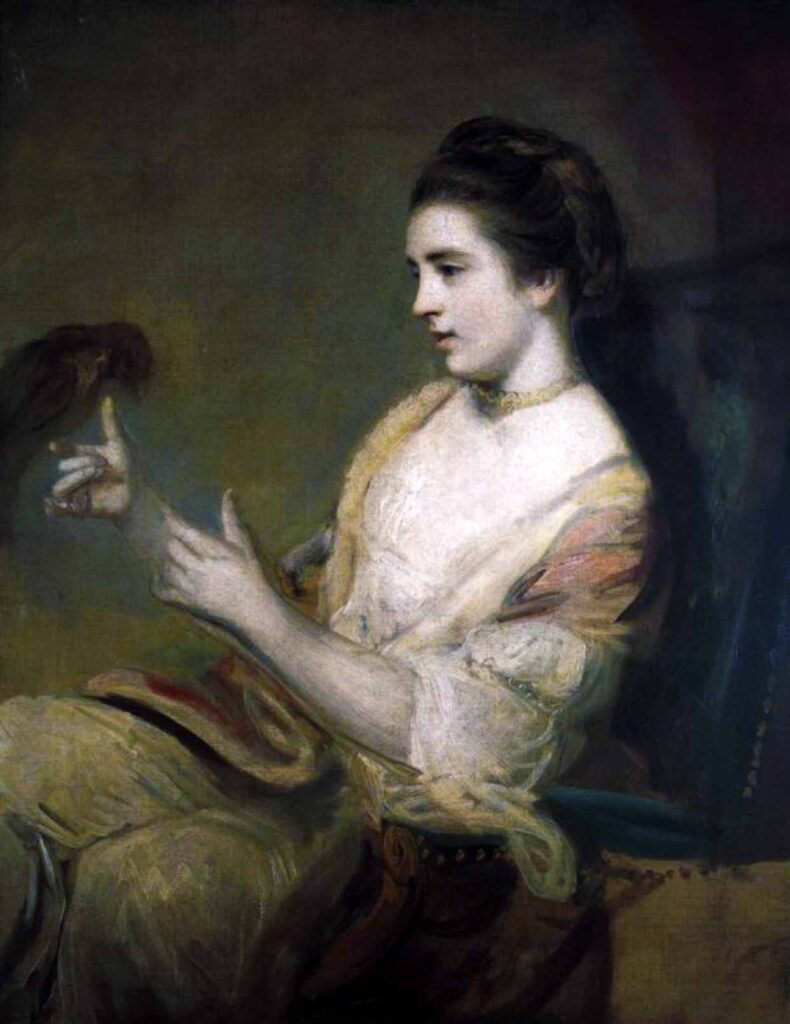
Kitty Fisher with a Parrot, Sir Joshua Reynolds, c. 1763–64. Oil on canvas. National Gallery, London. Public domain, via Wikimedia Commons.
Yet Fisher appears to have sought something more lasting than notoriety. In late 1766, she married John Norris, the son of a wealthy Kentish landowner and Member of Parliament.[xiv] By all accounts it was a love match, and Fisher retired from public life, withdrawing to Norris’s country seat at Hempsted Park in Kent. The marriage, however, was tragically brief. Fisher had long been using a fashionable lead-based cosmetic to whiten her skin—a common practice among women of the era, and one whose toxic effects were little understood.[xv] The lead had fatally weakened her constitution, and when tuberculosis took hold, she had no reserves with which to fight it.
Kitty Fisher died on 10 March 1767, barely four months after her wedding, at the age of just twenty-five, whilst on the way to seek a cure at the Bristol Hotwells. She died at The Three Tuns in Stall Street in Bath.[xvi] She was buried at Benenden Church in Kent, where, it is said, her husband insisted that all portraits and prints of her be buried with her—a poignant gesture from a man who wished his wife to be remembered as something more than a public spectacle. She left behind no memoirs, no letters of consequence, and no children. What she did leave was a template for a new kind of fame: one built not on birth or talent, but on image, audacity, and an instinctive understanding of the power of publicity.
NOTES
[i] The DNB entry for Catherine Maria Fisher gives her birth date as 1741. Her father, John Henry Fischer, was of German origin.
[ii] The phrase appears in a satirical pamphlet of 1759; see the Dictionary of National Biography, 1885–1900, entry for Catherine Maria Fisher.
[iii] Millinery as a common occupation for young women of modest means is discussed widely in social histories of Georgian London. See also the National Portrait Gallery’s biographical note on Fisher.
[iv] The date and circumstances of the riding incident are recorded in contemporary broadsheets and later compiled in biographical accounts. See Cindy McCreery, “Kitty Fisher,” Oxford Dictionary of National Biography (Oxford University Press, 2004).
[v] Scores of broadsheets, ballads, and satirical prints appeared within days of the incident, punning on Fisher as a “fallen woman.” See the British Museum’s satirical prints collection.
[vi] Reynolds painted Fisher on at least four occasions between 1759 and 1766. See David Mannings and Martin Postle, Sir Joshua Reynolds: A Complete Catalogue of His Paintings (Yale University Press, 2000).
[vii] The National Portrait Gallery’s entry on Fisher notes the suggestion that the fall may have been deliberately staged as a publicity manoeuvre.
[viii] On the broadside ballad tradition, see Patricia Fumerton and Anita Guerrini (eds), Ballads and Broadsides in Britain, 1500–1800 (Routledge, 2010).
[ix] The role of coffeehouses and periodicals in Georgian print culture is examined in Brian Cowan, The Social Life of Coffee: The Emergence of the British Coffeehouse (Yale University Press, 2005).
[x] On the dangers of lead-based cosmetics in the eighteenth century, see Kathy Stuart, “Beauty and the Beast: Cosmetics and Health in the Long Eighteenth Century,” in Medicine and the Market in England and Its Colonies, c. 1450–c. 1850 (Palgrave Macmillan, 2007).
[xi] On Kitty Fisher as a precursor to modern celebrity culture, see Stella Tillyard, “Celebrity in 18th Century London,” History Today, vol. 55, no. 6 (June 2005).
[xii] The “Cleopatra dissolving the pearl” portrait (c. 1759) is held by the Kenwood House collection (English Heritage). See Mannings and Postle, op. cit.
[xiii] The figure of £12,000 per annum and the detail of liveried servants appear in several contemporary accounts. See the Oxford DNB entry.
[xiv] John Norris (1741–1793) of Hempsted Park, Kent, was the son of John Norris MP. The marriage took place in late 1766.
[xv] On the dangers of lead-based cosmetics in the eighteenth century, see Kathy Stuart, “Beauty and the Beast: Cosmetics and Health in the Long Eighteenth Century,” in Medicine and the Market in England and Its Colonies, c. 1450–c. 1850 (Palgrave Macmillan, 2007).
[xvi] Fisher died on 10 March 1767 and was buried at St George’s Church, Benenden, Kent. See the parish records and DNB entry.
BIBLIOGRAPHY & SOURCES
McCreery, Cindy. “Fischer [married name Norris], Catherine Maria [known as Kitty Fisher] (1741?–1767), courtesan.” Oxford Dictionary of National Biography. 23 Sep. 2004; Accessed 7 Mar. 2026. https://www.oxforddnb.com/view/10.1093/ref:odnb/9780198614128.001.0001/odnb-9780198614128-e-9489.
Mannings, David and Martin Postle. Sir Joshua Reynolds: A Complete Catalogue of His Paintings. Yale University Press, 2000.
Tillyard, Stella. “Celebrity in 18th-Century London.” History Today, vol. 55, no. 6, June 2005.
Fumerton, Patricia and Anita Guerrini (eds). Ballads and Broadsides in Britain, 1500–1800. Routledge, 2010.
Cowan, Brian. The Social Life of Coffee: The Emergence of the British Coffeehouse. Yale University Press, 2005.
McCreery, Cindy. The Satirical Gaze: Prints of Women in Late Eighteenth-Century England. Oxford University Press, 2004.
“Catherine Maria Fisher.” Dictionary of National Biography, 1885–1900. London: Smith, Elder & Co.
National Portrait Gallery, London. Biographical entry for Catherine Maria (Kitty) Fisher.
Image Credits
Featured Image: Nathaniel Hone, Kitty Fisher, 1765. Oil on canvas, 749 × 622 mm. National Portrait Gallery, London (NPG 2354). Public domain, via Wikimedia Commons.
Sir Joshua Reynolds, Kitty Fisher with a Parrot, c. 1763–64. Oil on canvas. National Gallery, London. Public domain, via Wikimedia Commons.
“The Merry Accident, or a Print in the Morning: A Chair, a Chair, for the Lady,” c. 1759. Engraving. Library of Congress, Prints and Photographs Division, British Cartoon Prints Collection (LC-USZ62-132018). No known restrictions on publication.
Researched and drafted with AI assistance.