
Kitty Fisher in Somerset
A Diary Entry & a Besotted Earl
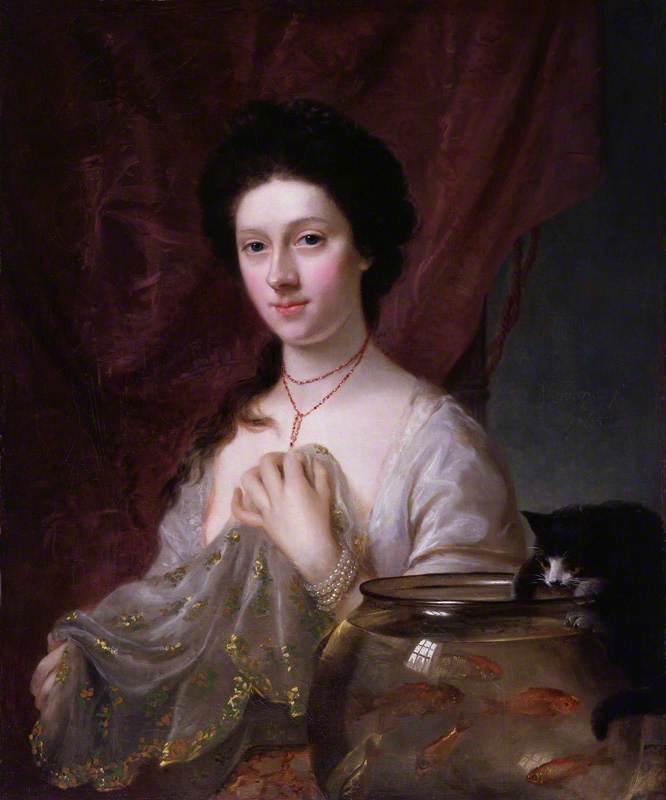
Hone I, Nathaniel; Kitty Fisher; National Portrait Gallery, London; http://www.artuk.org/artworks/kitty-fisher-156834
An Unexpected Entry
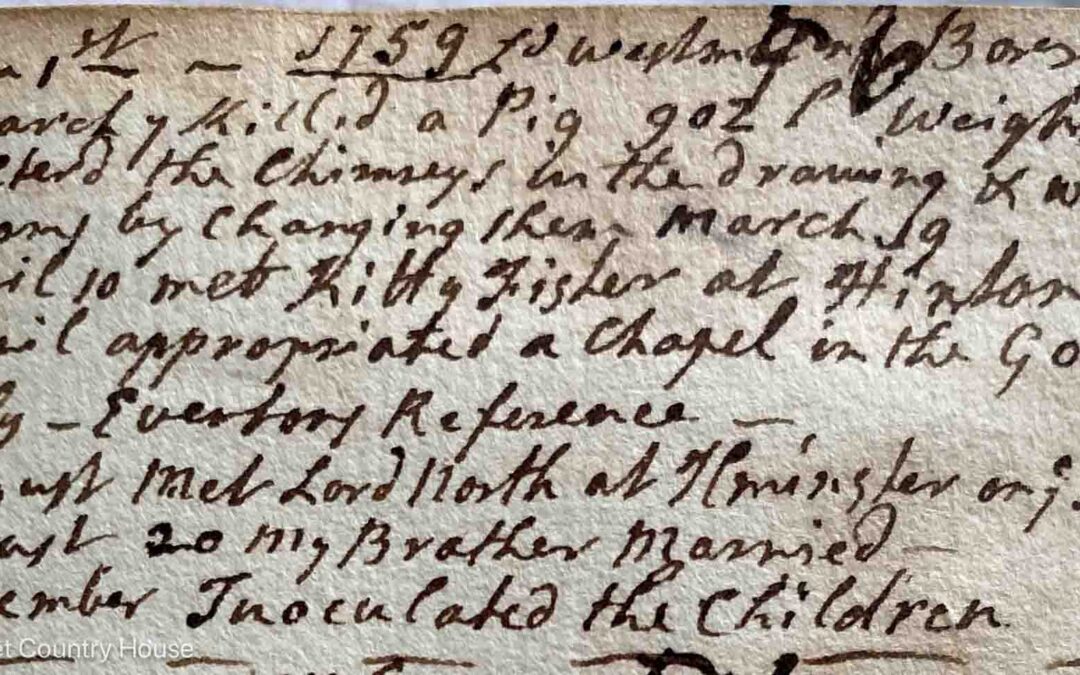
Among the papers preserved at Montacute House in Somerset, the diaries of Edward Phelips V offer an invaluable window into the daily life of a Georgian country gentleman. Phelips, born in 1725, was the master of Montacute, one of the finest Elizabethan mansions in England, and the fifth of his family to represent Somerset in Parliament.[i] His diary entries for 1759 are characteristically terse—recording the killing of a pig, alterations to chimneys, the inoculation of his children—but nestled among these domestic particulars is a line that connects rural Somerset to the most talked-about woman in London: “April 10 met Kitty Fisher at Hinton.”[ii]
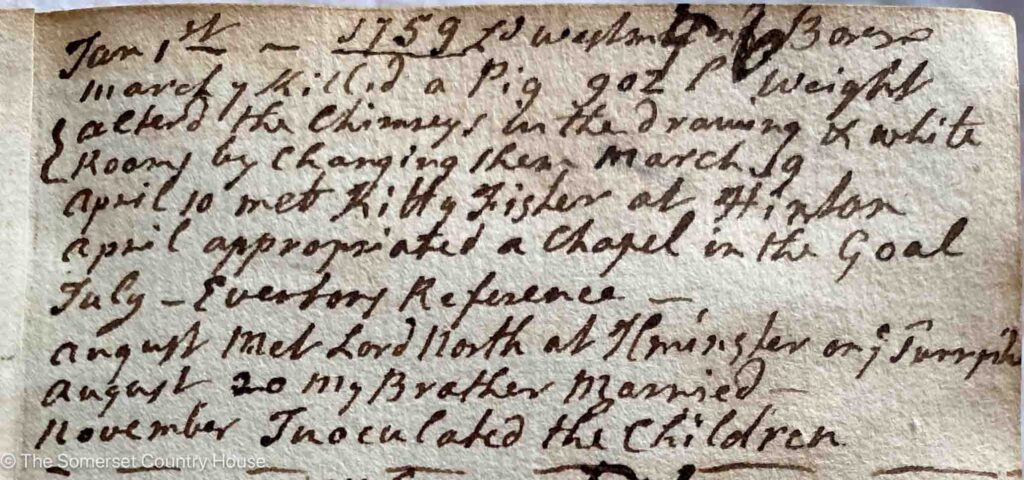
Extract from Edward Phelips V Diary 1759-73
Phelips was thirty-four years old at the time, a married man with six children ranging from a newborn baby to an eight-year-old eldest.[iii] A visit to a neighbour’s house—and the chance to meet the most notorious woman in the kingdom—may well have offered a welcome respite from the bustle of the nursery at Montacute. He says nothing more about her in his diary, which is a pity. But the bare fact of the entry is remarkable enough, for it places Kitty Fisher in the Somerset countryside barely a month after the incident in St James’s Park that had made her a household name. The fall from her horse and subsequent display of undress brought her instant notoriety.
The Earl of Poulett and Hinton House
“Hinton” was Hinton House, the seat of John Poulett, 2nd Earl Poulett, in the village of Hinton St George—just a few miles from Montacute.[iv] The Poulett family had been established there since the fifteenth century, and by the mid-eighteenth century the house and its park were among the finest in the county. The Earl himself, born in 1708, was by 1759 a man of fifty-one: Lord Lieutenant of Somerset, colonel of the county militia, and a bachelor.[v]
Poulett was, by all accounts, besotted with Kitty Fisher. He had invited her to spend the Easter of 1759 at Hinton House, and rumours soon circulated that the Earl intended to make the famous courtesan a countess.[vi] The timing is suggestive. Fisher’s fall from her horse in St James’s Park had occurred on 12 March 1759, just a month before Phelips met her at Hinton on 10 April. It is tempting to speculate that Fisher had retreated to the relative obscurity of rural Somerset to escape the storm of satirical prints, ballads, and broadsheets that had engulfed her in London. Poulett’s country house, deep in the Somerset countryside, would have offered a discreet and comfortable refuge.
Yet the age gap between them was considerable—Poulett was fifty-one to Fisher’s seventeen—and the Earl was apparently advised against marriage. Whether the counsel came from family, friends, or his own sense of propriety, no proposal was forthcoming.[vii] Poulett never married at all. He died, still a bachelor, on 5 November 1764 at Hinton House. Edward Phelips recorded the death of his neighbour in characteristically plain terms: “…in the beginning of November died my neighbour & friend John Earl Poulett at George Hinton of a violent seizure of the gout in his head & stomach. His death was not unexpected he having been very ill some time.”[viii] The earldom passed to his brother Vere, of whom Phelips felt very differently. When Vere died in 1788, he wrote “On the 16th of April died Vere Earl Poulett a neighbour but latterly no friend to me nor my family having entertained the most ill-founded & unjust prejudice towards me”.[ix]
Lucy Locket and Kitty Fisher
Kitty Fisher’s fame was such that her name found its way into the most unlikely of places—a children’s nursery rhyme. The verse, first recorded in print by James Orchard Halliwell in 1842 but almost certainly much older, runs:[x]
Lucy Locket lost her pocket,
Kitty Fisher found it;
Not a penny was there in it,
Only ribbon round it.
The meaning of the verse has been much debated. Halliwell himself suggested that Lucy Locket and Kitty Fisher were “two celebrated courtesans of the time of Charles II,” though no supporting evidence for a Lucy Locket of that period has ever been found.[xi] The more widely accepted interpretation links the rhyme to the eighteenth-century Kitty Fisher and the world she inhabited. In the slang of the period, a “pocket” could refer to a wealthy patron or keeper—a man who funded a courtesan’s lifestyle. The rhyme, on this reading, tells the story of a rich admirer who was “lost” (that is, abandoned or dropped) by one woman, Lucy, and “found” by another, Kitty—only for Kitty to discover that there was “not a penny” left in him, his fortune already spent. Whether or not the verse records a specific incident, it captures something of the precarious, transactional world of eighteenth-century courtesanship—and it is a measure of Kitty Fisher’s celebrity that her name survived in the mouths of children long after the scandals that made her famous had been forgotten.
A Fleeting Glimpse
Edward Phelips’s diary entry is tantalisingly brief. We do not know what he made of Kitty Fisher, whether they exchanged more than pleasantries, or what the young courtesan thought of rural Somerset. But his five spare words — “met Kitty Fisher at Hinton”— are a small, vivid thread connecting the quiet world of a country gentleman and his six children to the glamour, scandal, and celebrity of Georgian London. They remind us that even in an age before railways, news—and the people who made it—travelled further and faster than we might suppose.
NOTES
[i] Edward Phelips V (1725–1797) of Montacute House, Somerset. He married Maria Wright c. 1747 and served as MP for Somerset. See “PHELIPS, Edward (1725–97),” History of Parliament Online.
[ii] Diary of Edward Phelips V, entry for 1759. The diary is part of the Phelips MSS held at Montacute House. Image of the diary entry © The Somerset Country House.
[iii] Phelips married Maria Wright c. 1747 and they had four sons and three daughters. By 1759 their children ranged from approximately eight years old to a newborn.
[iv] Hinton House, Hinton St George, Somerset, was the seat of the Poulett family from c. 1430 until 1968. See Parks & Gardens UK entry for Hinton House.
[v] John Poulett, 2nd Earl Poulett (10 December 1708 – 5 November 1764), styled Viscount Hinton until 1743. He was appointed Lord Lieutenant of Somerset in 1744 and colonel of the 1st Somerset Militia from 1759.
[vi] On Poulett’s invitation to Fisher and the marriage rumours, see Cindy McCreery, “Kitty Fisher,” Oxford Dictionary of National Biography (Oxford University Press, 2004). Also “Who was Kitty Fisher?” Great British Life.
[vii] Poulett died unmarried. The age gap: Poulett was born 1708, Fisher in 1741, making them fifty-one and seventeen respectively in April 1759.
[viii] Autobiography of Edward Phelips V, entry for late 1764, S.R.O., ‘Autobiography of Edward Phelips (1725-97), c1794’, Phelips Manuscripts, Personal affairs, DD/PH/224/114.
[ix] Autobiography of Edward Phelips V, entry for late 1788, S.R.O., ‘Autobiography of Edward Phelips (1725-97), c1794’, Phelips Manuscripts, Personal affairs, DD/PH/224/114.
[x] The rhyme was first published in James Orchard Halliwell, The Nursery Rhymes of England (London, 1842). See also Iona and Peter Opie, The Oxford Dictionary of Nursery Rhymes (Oxford University Press, 1951).
[xi] On the various interpretations of the rhyme and its connection to the historical Kitty Fisher, see “Lucy Locket,” Wikipedia, and “A Short Analysis of the ‘Lucy Locket Lost Her Pocket’ Nursery Rhyme,” Interesting Literature.
BIOLOGRAPHY & SOURCES
McCreery, Cindy. “Fischer [married name Norris], Catherine Maria [known as Kitty Fisher] (1741?–1767), courtesan.” Oxford Dictionary of National Biography. 23 Sep. 2004; Accessed 7 Mar. 2026. https://www.oxforddnb.com/view/10.1093/ref:odnb/9780198614128.001.0001/odnb-9780198614128-e-9489
Halliwell, James Orchard. The Nursery Rhymes of England. London, 1842.
Opie, Iona and Peter Opie. The Oxford Dictionary of Nursery Rhymes. Oxford University Press, 1951.
“PHELIPS, Edward (1725–97), of Montacute, Som.” History of Parliament Online.
The Somerset Country House. “Edward Phelips V of Montacute House.” thesomersetcountryhouse.co.uk.
“Who was Kitty Fisher, the famous 18th-century courtesan?” Great British Life, < https://www.greatbritishlife.co.uk/magazines/somerset/23531536.kitty-fisher-famous-18th-century-courtesan/> [accessed 7 March 2026]
“John Poulett, 2nd Earl Poulett.” Wikipedia.
S.R.O., ‘Autobiography of Edward Phelips (1725-97), c1794’, Phelips Manuscripts, Personal affairs, DD/PH/224/114
Image Credits
‘Diary of Edward Phelips (1725-97), 1759-73’, Montacute House MSS, National Trust. Image © The Somerset Country House.
Nathaniel Hone, Kitty Fisher, 1765. Oil on canvas, 749 × 622 mm. National Portrait Gallery, London (NPG 2354). Public domain, via Wikimedia Commons.
Researched and drafted with AI assistance.